1st orgy
COGNITIVE ORGIES
Individual Post
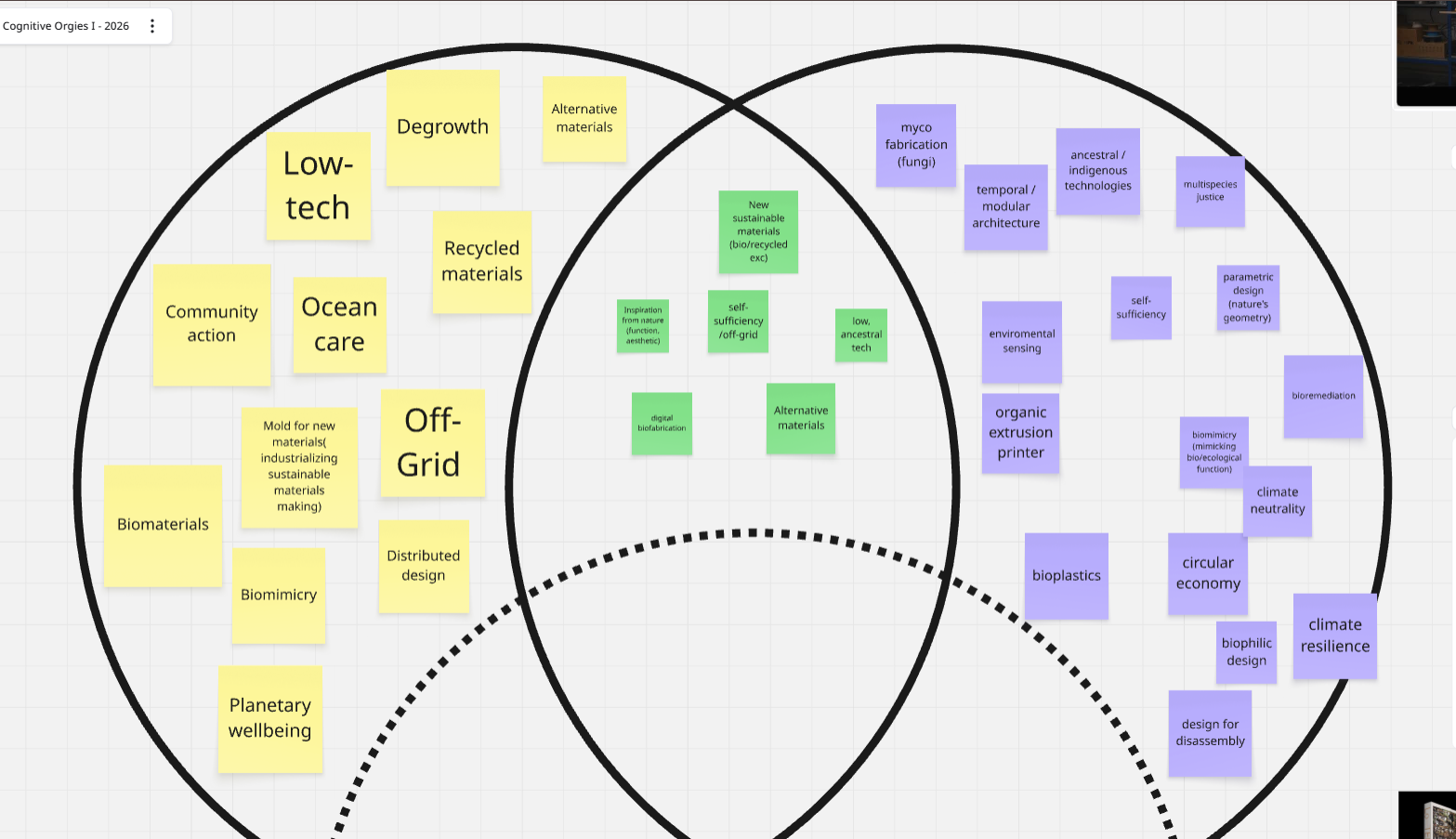
In this course I teamed up with another student, Melissa, to develop an idea and bring it to life in 4 intense days. We started this journey by making a diagram to see which of our interests crossed and which interests we thought would be meaningful for us to start building from there.
After that, we decided that our approach for the project would have been guided by this direction:
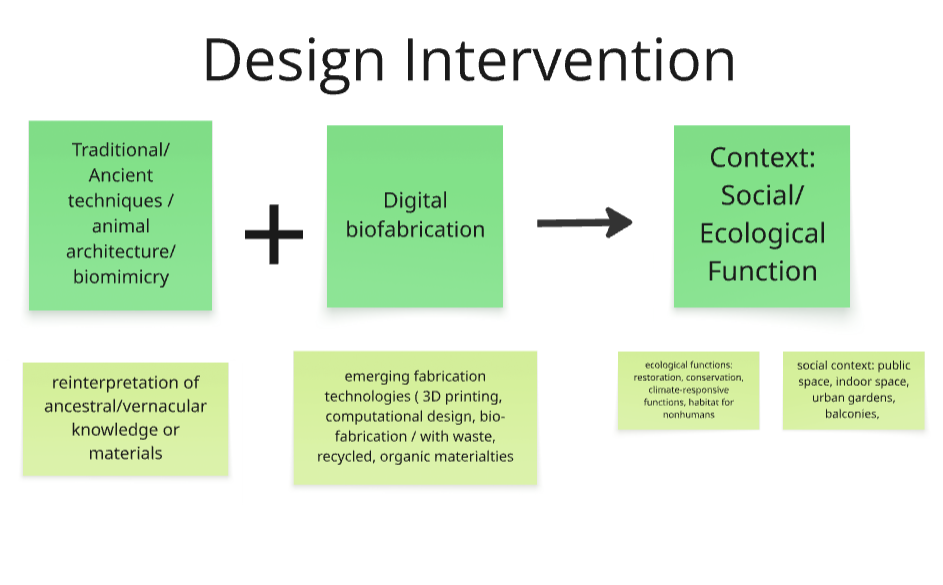
• Nature as inspiration: both to learn from nature and to design for planetary health and multi-species wellbeing. • Ancestral knowledge: vernacular, indigenous and traditional knowledge that is ecologically sustainable. This also included the recognition of nature intelligence, for example in fields such as biomimicry and animal architecture. • Emerging tech: digital biofabrication was a good term to encompass our interest in molds and scaffoldings that can be used to collaborate with biological systems or create new materialities. • Context: design that is social-ecological relevant.
It can seem that these commonalities would made landing on an idea easier, however, because we had so many interests in common, we also ended up with many potential ideas. Our conceptual brainstorming perhaps took too much time, given the overall time we had. It took us 2 days to commit to one idea. Our initial 4 options were:
• Balcony plug-in habitat for pollinators • 3D printed heat refuge for cities • Passive cooling technique for houses • 3D printed sculpture for marine restoration
Cognitive Traces
I wouldn’t say that me and my teammate changed too much our way of thinking as we were both on the same line of thinking from the beginning. Maybe some assumption that we doubted is that we need an industry level tools and skills to fabricate something that would actually make a change; we started the project being a bit worried that it would have been hard to 3d print with clay and build an actual artifact in such a short time but in the end we were happy taht we managed and reached a very good level of development given the time constraints. It was very pleasant to see that with the right help from the Fablab people we could actually develop things almost as we imagined them in our heads.
Moral Traces
I’d say that me and my teammate didn’t have a lot of disagreement during the developing of the project, as at that point we were already kind of aligned on what we wanted to obtain as a final outcome. The moment where we discussed the most it’s surely been the initial concept phase; Melissa is often very interested in other species consideration, and while I believe it’s very important to take that into consideration when designing, in the end I’d say I care more about the relationship between humans and the planet and about caring about it, as I think that taking care of the planet always eventually translates into doing something that has a positive impact on the beings that inhabit the planet itself. So if she wanted to do something regarding the care of the soil, I maybe wanted to work on reducing our energy consumption as humans and if she wanted to build an artifact to help marine life, I was more inclined to find a solution to less pollute the ocean. Besides this small differences in the types of challanges we wanted to tackle, I have to say that after we agreed on the final concept there was almost no conflict, also because the strict schedule didn’t really allow too much fighting, but required fast solving and tight cooperation. As regards the distribution of work, It came naturally because of our different backgrounds: coming from an industrial design background,I was in charge of the most practical sides like sketching the tilem 3d modeling it and printing it to then be able to generate a mold, modeling the honeycomb structure to 3d print with clay and find a way to make my 3d to communicate with the hacked clay printer. While I was doing so Melissa, with her more scientific and research based background and her biomaterials expertise, was in charge to find recipes for the different mixes for the tile layers and the production of the hydrogel spheres. As we went further in the project, I was then responsible of creating the wooden formwork to pour the aereoconcrete in and to actually study the recipe of this concrete, create the mixture, work it and pour it into the formwork, while Melissa produced The biobased mold for the clay mix recipe and worked with the said clay mix. As for the documentation of the processes and the building of the presentation, the one who had free hand in the processes for a second filmed the other and uplaoding to hackster.io we basically did everything each one of us could do as fast as we could so we didn’t really have the time to divide the work in that sense. Overall I feel like we managed to split the workload very well as both of us felt we did half of the total work.
Technical/Process Traces
While developing the project, some things/parts broke and many resisted.
Things that broke:
- one of the two biomold ( the pressure applied while trying to obtain the tile broke the part that was connecting the wall and the base)
- two of the honeycomb 3d printed structures, one broke while being moved, the other was broken by the air that came out from the nozzle when the clay mixture was finished ( we didn’t notice the mixture was over because the sides of the plastic container looked like there was still a 20% of material inside, but what happened is that the material was left on the walls but in the middle of the container was finished and so a powerful shot of air broke the piece)
Things that resisted:
- One biomold ( the thicker one)
- 6 honeycomb 3d printed clay structures
- Top layer clay based mixture tile
- Top layer concrete tile ( still drying up to today)
- Hydrogel spheres
Hacks:
-
To be able to obtain the desired honeycomb pattern shape and be sure that the 3d printer would do the correct path while printing clay, from Rhinoceros we had to export just the middle line that defines the shape and import it in Grasshopper using the plugin Mamba to generate the gcode to finally paste it in the gcode window in the printer program.
-
To generate the clay based tile we had to split the clay in super small pieces before uniting it with the others components of the recipe.
-
To 3d print clay we had a compressor to give pressure into the plastic container of the material and we found out that the best pressure quantity was 0.8 bars.
General final reflection
The cognitive orgies week has been as intense as interesting to me. Having to produce an outcome in such a short amount of time brought some stress and tension, but looking back at it I totally loved the process and what came out of it. Both me and my teammate, Melissa, were happy about the outcome and what allowed us to learn during the days. It was very nice for us to be able to tackle a tangible problem that could have been dealed with some skills that were decently feasible to acquire in this intensive 4 days. As challanging as it was, we always had a positive mindset when working because we had the feeling that with our tutors we could have reached what we wanted and that’s not to be given for granted. The only thing that I would maybe do differently is to arrive with a concept almost already defined at the first day, because I feel that it would allow for a much more developed final artifact. This time me and Melissa took a lot of time to define exactly what we wanted to build, and while it was surely important to aim in the right direction, I feel like we lost quite some time we could have used to work on the project itself. Apart from this, I was very happy that I was able to work with a hands on approach, since it’s something that I personally lacked a lot with my previous degree that was very focused on digital and intangible outcomes. Getting dirty and trying to actually build things has been very meaningful to me and even though we didn’t reach a full developed stage because of obvious time constraints, I could experience the process and I could see the fesasibilty of the project also in a further development stage. Getting to gain experience in 3d printing with clay was also very important for me, it was something that was fascinating me since I stepped inside IAAC main hall and finally I had the chance to do it even if in a smaller scale. Overall the course was very well structured and left me satisfied with the process of learning and with the outcome. About the outcome itself, me and Melissa are probably willing to develop it to a further stage, as we wanna see the effectiveness of it and its true potentiality and scalability: this four days have surely been a great spark to start a deeper exploration.